
10 tips for peony lovers

Nothing compares to the luxury of blooming peonies. The palette of colors, shapes, and scents of these flowers allows gardeners to become true artists. Every year, new excellent varieties appear that you want to find a place for in your garden. How can you get the most out of peonies in your flower garden?
1. Commandments for peony lovers
To achieve success in growing peonies, follow these five simple rules:
- Choose herbaceous varieties and intersectional, or Ito hybrids, which will not have problems with wintering (tree peonies require shelter for the winter);
- Buy only large, good-quality divisions;
- Plant them in fertile, slightly acidic soil with good drainage (to determine what type of soil you have on your site, see the article How to determine your soil type and why you need to know).
- Provide the plants with at least six hours of direct sunlight and good air circulation.
- Keep an eye out for weeds and remove competing plants.

2. Companion flowers
Many perennials that bloom at the same time as peonies will serve as a beautiful backdrop for them in the flower garden.

Perennials that bloom alongside peonies will make a beautiful frame for them.
These are aquilegia, astrantia, baptisia, brunnera, mountain cornflower, carnations, geraniums, delphinium, dicentra, irises, bellflowers (except for aggressive species such as spotted bellflowers or rapunzel-like bellflowers), ornamental bows, lupine, poppy, cuff, meadowfoam, tiarella, and wood sage.

3. Peonies in meadow flower beds
Luxurious peonies are best suited for traditional English mixed borders in cottage gardens. However, modern designers working in the new wave style also use peonies in their flower beds, which are more like a flowering meadow than a hand-crafted flower bed. Of course, it is not double varieties that are used, but natural species and single-flowered hybrids. They will go best with grasses and umbelliferous plants — the basis of modern meadow flower beds.

Peonies in meadow flower beds
Renowned Dutch garden designer Piet Oudolf, founder of the “new perennials” movement, uses species peonies in his work: Weich, Wittmann, foreign, medicinal, Mlokosevich, thin-leaved, Emoda. He also has his favorite hybrids, which he considers elegant enough to fit into a natural garden. These are ‘Bowl of Beauty’, ‘Clair de Lune’, ‘Jan van Leeuwen’, ‘Mai Fleuri’, ‘Postillon’, and ‘Red Charm’.

4. Peonies and spring bulbs
Small bulbous plants—snowdrops, iridodictyums, crocuses, chionodoxas, muscari, botanical tulips, daffodils—bloom long before peonies. They help decorate the space that will later be occupied by the bush (a large adult specimen can cover more than a square meter) and complement the peony’s bright spring shoots. When the small-bulb plants have finished flowering and their leaves begin to dry out, the beautiful foliage of the peony will cover up this unsightly picture.

Left: peonies and muscari. Right: peonies and roses.

5. Peonies and roses
Just like in bouquets, peonies and roses are delightful companions in the garden. Shrub roses and climbing roses on obelisks, arches, and pergolas are unrivaled as backdrops for a peony garden. Modern ground cover roses and low floribundas can also be neighbors to peonies in a mixed border.
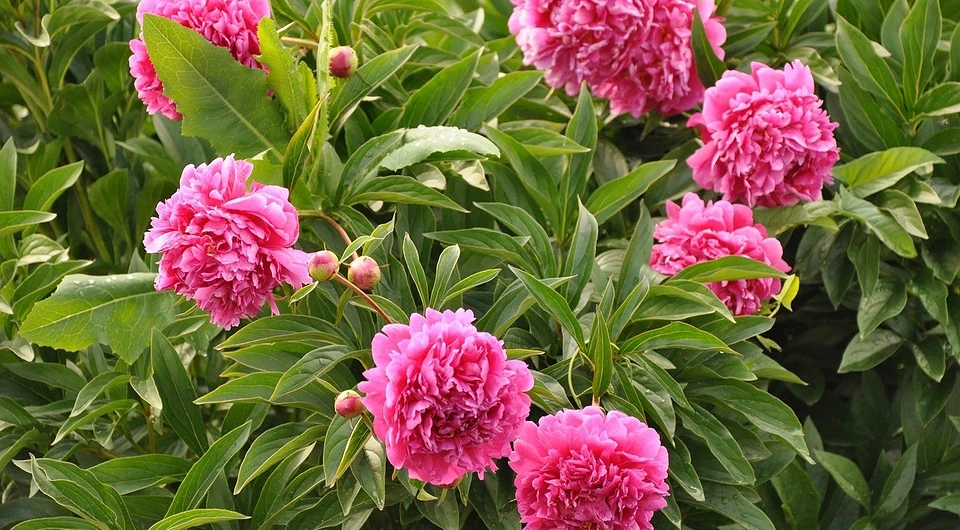
6. Combining foliage and flowers
Peonies bloom profusely and stunningly, but for a relatively short time. Therefore, our heroes need to be paired with perennials that reach their peak of decorative appeal before or after the peonies bloom. This combination is mutually beneficial. The foliage of the partner plants will create a beautiful backdrop for the luxurious peony flowers, and the peonies’ carved leaves will accentuate the flowers of these perennials.
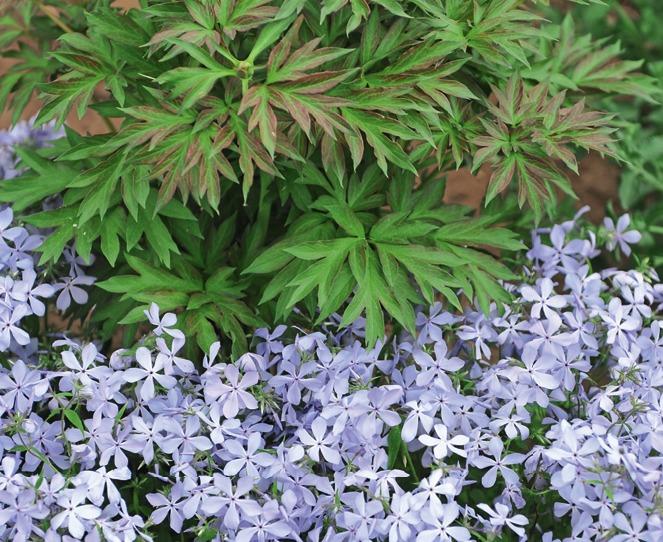
Combining foliage and flowers
Ideal candidates: Karmichael’s aconite, amsonia, autumn anemones, autumn asters, badan, Waldsteinia, veronica, veronicastrum, heuchera, catmint, clematis, catnip, hellebore, sedum, spreading and paniculate phlox, woolly stonecrop, large-flowered bellflower, and many other plants.

7. Peonies in rockeries
And treasures can be found among the rocks.

Peony in a rock garden
Thin-leaved peony, with its delicate, finely dissected leaves and scarlet flowers, will adorn any rocky flower bed.

8. Reliable support
Whether or not a peony needs support depends on the variety. Many old double and semi-double cultivars and large-flowered varieties of milk-flowered peonies need it, while some peonies do without. If you don’t want any extra hassle, choose non-double, anemone-like, and Japanese varieties—many of them do not require support. If support is still necessary, there are several options for providing it.
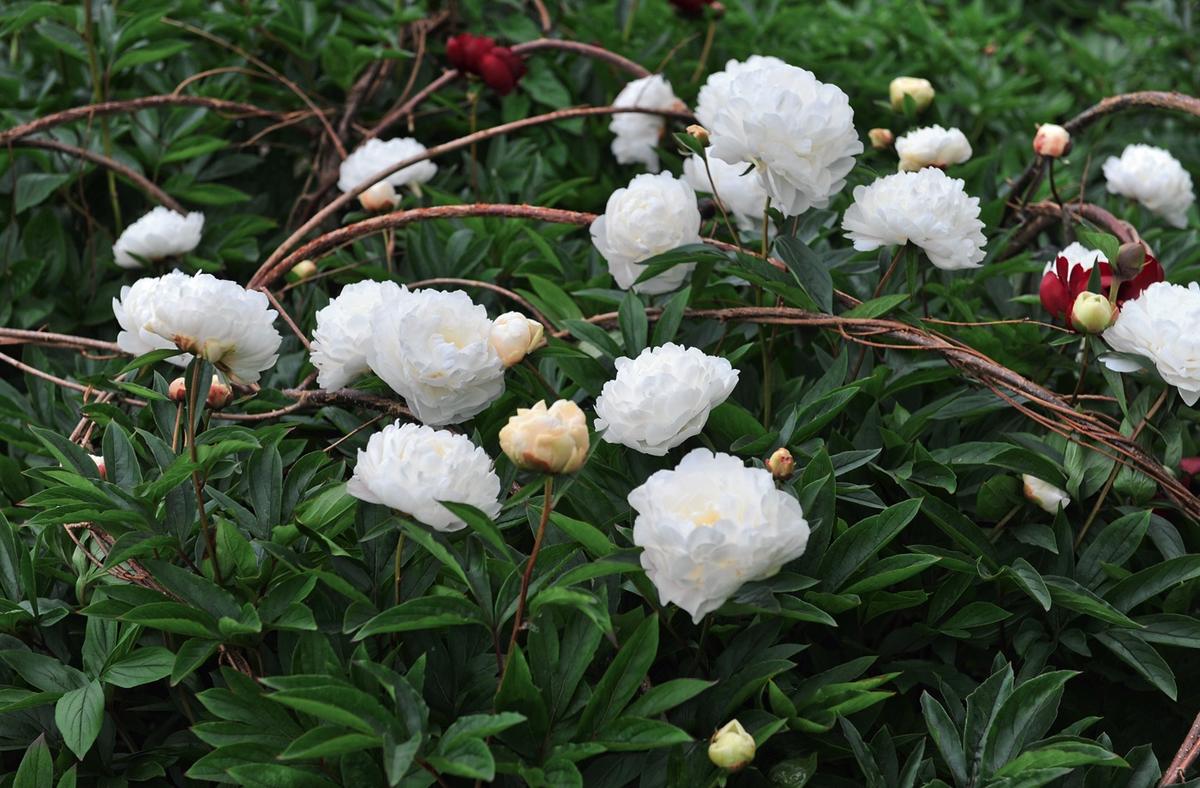
Whether or not a peony needs support depends on the variety.
You can buy a ready-made plastic “ring on legs” at a garden center. Or even better, a more expensive but more reliable and elegant pyramid made of rods with rings in several tiers, through which the peony will grow.
A cheap but desirable option is to use flexible branches from shrubs left over from spring pruning as supports. If necessary, individual flowers can be tied to bamboo sticks or other similar supports.

9. Pinching buds
This technique is used when you want to grow huge flowers for cutting. You can even show them off at a flower show. Pinching means removing the side buds on each flower stalk before they reach pea size. This operation will allow the plant to put all its energy into the top bud, leaving the remaining flowers absolutely irresistible. In addition, the load on the flower stalk will be less, and it will bend less.

Pinching will allow the plant to put all its energy into the top bud.
If you don’t pinch off the side buds, the flowers will be smaller, but the bush will bloom for longer. By the way, you can almost always find ants on peony buds. They are attracted by the sweet secretion produced by peony buds. They do not harm the plant.

10. Should you cut off wilted flowers or not?
Most gardeners choose the first option. Removing faded flowers gives the bush a much neater appearance, reduces the likelihood of fungal diseases, and allows the peony to conserve its energy for seed production and ripening. Wilted flowers are removed by cutting the flower stalk above the first trifoliate leaf.
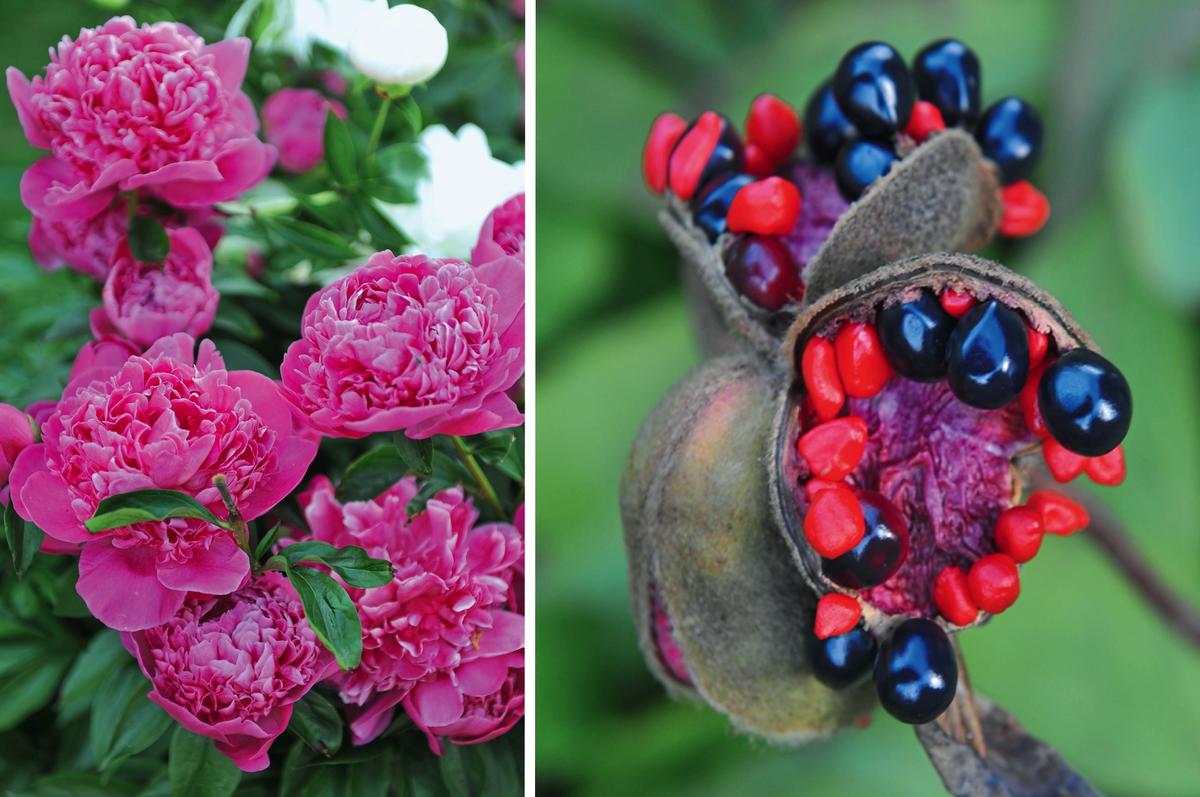
Should I cut off the faded flowers?
But gardeners who grow species peonies know that it makes sense to leave everything as it is, and then in the fall, they will be rewarded with a magnificent, mesmerizing sight. As the decorative fruits ripen, they will open up and reveal red and black seeds on a wine-red background.

❓ Questions and answers

When is the best time to plant peonies in the U.S.?
The best time to plant herbaceous peonies is in the fall, usually September through early November, when the soil is still warm and roots can establish. Please don't forget to stop planting in midsummer heat. This timing gives them a head start for an intense bloom next spring.
Can I grow peonies in containers if I live in a small space?
Yes — dwarf or hybrid peonies can do well in large containers (12 inches or more in diameter) with good drainage, fertile soil, and full sun. Just make sure they’re planted deep enough (soil level covering the “eyes” about 2 inches below surface) and aren’t over-watered.
What should I do when the peony blooms fade to keep the plant healthy?
After your peony’s flowers fade, cut off the spent blooms to keep the plant looking tidy and reduce the risk of fungal issues. In the U.S., this is especially helpful if you’ve grown hybrid varieties for showy flowers; for species types, you may choose to let the seed pods form for fall interest.
Sofia Lorenson: An expert in floriculture and floristry with 10 years of experience. I will help you create the garden of your dreams, which will bloom from spring to fall.



1 Response
[…] 10 tips for peony lovers […]