
Features of planting peonies: how to achieve lush flowering?

We explain how to choose a seedling, where to place it, and when to plant.
Lush, beautiful peonies look equally good on their own or in groups. With proper care, they will become a real decoration for any flower bed or garden. It is essential to know that the plant’s future is determined at the time of planting. Mistakes made during planting are complicated to correct, and sometimes impossible. Let’s figure out how to plant peonies so that they grow strong and delight us with lush blooms.
All about planting peony bushes
Species characteristics
Peonies are perennial flowering herbaceous plants. They can grow in one place for decades. Peonies are diverse, with about 50 varieties. This decorative perennial grows in Europe, Asia, America, and North Africa. There are also wild varieties of the flower. Based on several characteristics, two types of plants are distinguished: herbaceous and tree-like.
Herbaceous plants, which are most often grown in Russian flower gardens, grow above ground every spring. In the fall, they die off. The cycle repeats annually. In tree-like plants, the above-ground parts gradually become covered with a thin crust. Over time, a grayish-colored bark forms. The height of the woody shoots is 35-39 inches (90-100 cm).
Both varieties bloom in spring and summer. There are early, mid-season, and late-blooming varieties. Therefore, flowering peony bushes can be seen both at the end of May and at the beginning of July. After flowering, round capsules with seeds resembling pomegranate seeds form on the branches. You can grow a new bush from them, but it is easier to do this with divisions, i.e., fragments of the overgrown rhizome.

Species characteristics | Pixabay

Where to plant peonies on your plot
This flowering perennial is demanding when it comes to planting location. For abundant and bright flowering, pay attention to the first important point—lighting. A lack of light is unacceptable: even in partial shade, let alone full shade, the shoots will stretch out. The branches become pale and weak, and the bush literally “falls apart.” It may produce flowers, but the buds will be small and faded. The best place for the plant is an open area where it can enjoy at least 6 hours of morning sunlight.
The plant is also demanding in terms of soil composition. It likes a fertile, loose substrate. The acid-alkaline level should be neutral or, at worst, slightly alkaline. Acidic soil will immediately kill the flower.
Cold weather is also detrimental to it. This heat-loving plant cannot tolerate drafts, as they weaken its immune system. So, you can choose areas of the garden that are sheltered from the wind for planting.
Another enemy of the peony is excess moisture. Waterlogging is fatal to the root system. As a result, low-lying areas where moisture accumulates and the swampy regions should be immediately crossed off the list of places where it is best to plant peonies. If it is less than 31.5-33.5 inches (80-85 cm), the perennial will suffer. Its roots grow deep and wide, so that underground moisture oppresses the bush.
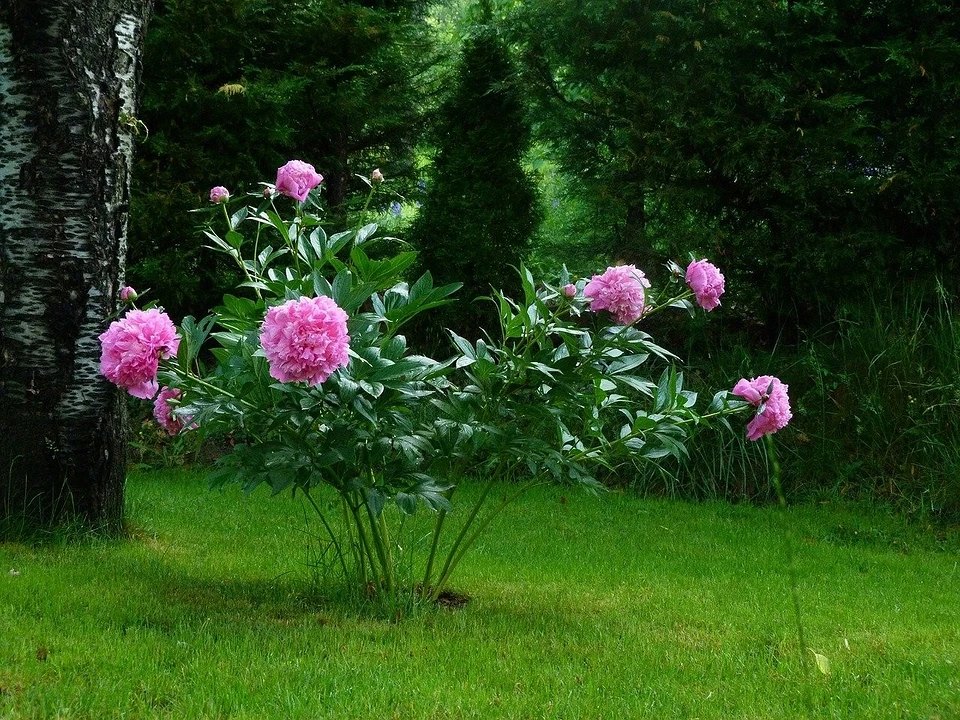
Where to plant peonies on your plot | Pixabay

Optimal planting times
The plant’s characteristics determine when to plant peonies. There are two cycles of active root system growth. The first occurs during spring awakening, from late April to early May. The second occurs during winter preparation, i.e., late August to early September. During this time, lateral suction roots grow abundantly. If you plant a bush in a new place before the start of this period, it will quickly and painlessly take root in its new location.
Spring and fall planting of peony bushes is possible, but survival rates differ. Why is this the case?
In spring, the sun is very active, and the average daily temperature is steadily rising. As a result, we have less-than-ideal conditions for a plant just taking root in a new place. In the heat, the leaves actively evaporate moisture, which the roots, which have not yet grown, extract from the ground with incredible difficulty.
Therefore, bushes transplanted in the spring lag behind their “autumn” counterparts in flowering and development for the first two to three years. Later, this lag is leveled out. If spring planting is planned, it is essential to calculate the timing accurately. The division should wake up, but not yet start to grow. For southern regions, the best time is early to mid-April. In colder areas, it shifts to early May.
When “waking up,” the root system is pliable and soft, but as summer approaches, it will increase and compact. If you divide it later, the risk of injury increases, leading to the suppression of the seedling. It will take a long time to take root and will be unhealthy. Delaying transplanting is also dangerous because by the beginning of the hot season, the bush will not have time to develop the necessary root mass, leading to moisture stress.
The best time for autumn transplanting in southern regions is October, and in colder areas, September. The plant will have fully recovered after flowering, grown stronger, and formed mature renewal buds. There is no heat at this time, which means it will not suffer from a lack of moisture. It is essential to plant the division at least a month before the first frost. Otherwise, the root system will not have time to form and prepare for the cold.

Optimal planting times | Pixabay

Beginning gardeners often wonder if it is possible to plant peonies in the summer. It is essential to understand that July and June are the flowering season. During this time, it is strictly forbidden to transplant bushes. And it is not recommended to do so in August either. The flower accumulates nutrients, lays down, and grows recovery buds. Therefore, if it is really necessary, the plant is transplanted in August, closer to the end of the month.
How to choose a division
A division is considered to be a seedling of a herbaceous peony — a fragment of the rhizome with several buds. Experienced flower growers consider the best choice to be a seedling with approximately the same number of stems and root shoots. There should be three to five renewal buds. More than that is undesirable, as the division will need too much energy to grow. Until it takes root, this can lead to disease and death. One or two buds are also not good, as both may turn out to be unviable.
The rhizome should be carefully examined: there should be no knot-like growths. They are home to nematodes — small parasitic worms. It is tough to cure a plant affected by them. Any growths on the root shoots are most likely cancer. Such a seedling is unlikely to take root and develop normally. The roots should be clean, with no signs of rot or softening. A dark purple or whitish coating may indicate a fungal disease. It is essential to understand that only a completely healthy cutting will take root quickly and develop actively.
-

- How to choose a division | instagrampion_volgograd


Proper planting
You can start planting by preparing the planting hole. It is best to dig it two to three weeks before planting. This will allow the soil to settle naturally, enabling you to grow the seedling at the “correct” depth.
The width, length, and depth of the hole should be approximately the same—27.6-31.5 inches (70-80 cm). Peony bushes proliferate, so they need a lot of space. When preparing the hole, keep the distance between peonies in mind. Each plant should be separated from the next by at least 39 inches (100 cm).
The soil removed from the hole will be replaced later, so it must be prepared in advance. Acidic substrate should be deacidified. To do this, add dolomite or slaked lime. The soil mixture should be loose: heavy clay soils are mixed with sand. On the contrary, a little clay is added to overly loose sandstones.
Could you please add fertilizer? In this case, any phosphorus-potassium complex is suitable.
If you do not plan to use the removed soil, you can mix a backfill substrate. Take one part sand, one part peat, and two parts humus or compost. Add a suitable mineral complex or ash. Mix everything well — the backfill is ready. Be sure to lay drainage at the bottom of the hole to remove excess moisture from the root system. This can be crushed stone, pebbles, expanded clay, or broken brick. Sand is poured on top to fill the voids between the large fragments. A bush is planted in the finished planting hole.
How to plant peonies:
- If the weather is dry, water the hole. Allow the moisture to soak in.
- Try out the division, see how much substrate you need to pour under the root so that the renewal buds are at a depth of 1.2-1.6 inches (3-4 centimeters). This is the average value. For heavy soils, leave 1 inch (2.5 cm); for light soils, leave 1.6-2 inches (4-5 cm). If the hole has not yet settled, reduce the planting depth by 0.4-0.8 inches (1-2 cm) to allow for subsequent settling.
- Add soil to the bottom of the hole so that the seedling is at the correct planting depth. Tamp down the substrate with your hands.
- Place the seedling in the prepared spot and carefully cover it with substrate. Could you tamp down the soil mixture around the seedling?
- Water the planted bush generously. Allow the moisture to soak in, then cover the space around the shoots with mulch.
-

- How to plant peonies |


Post-planting care
The first season after planting is crucial to the crop’s normal development. It must overwinter normally. To prevent frost damage, it is best to cover it for the winter. Spring and summer care consists of timely watering. It is better to postpone feeding until next year. What is laid in the planting hole will be enough for the plant for the first year of its life.
When peonies bloom after planting depends on the time of transplanting and the variety. Some spring-planted seedlings try to bloom in the summer, while all autumn-planted ones produce buds in the spring. Since the main task of a young bush is to gain root mass, it is better to postpone flowering. All buds are removed, leaving one or two, no more. This is enough to see the new variety without destroying the bush.
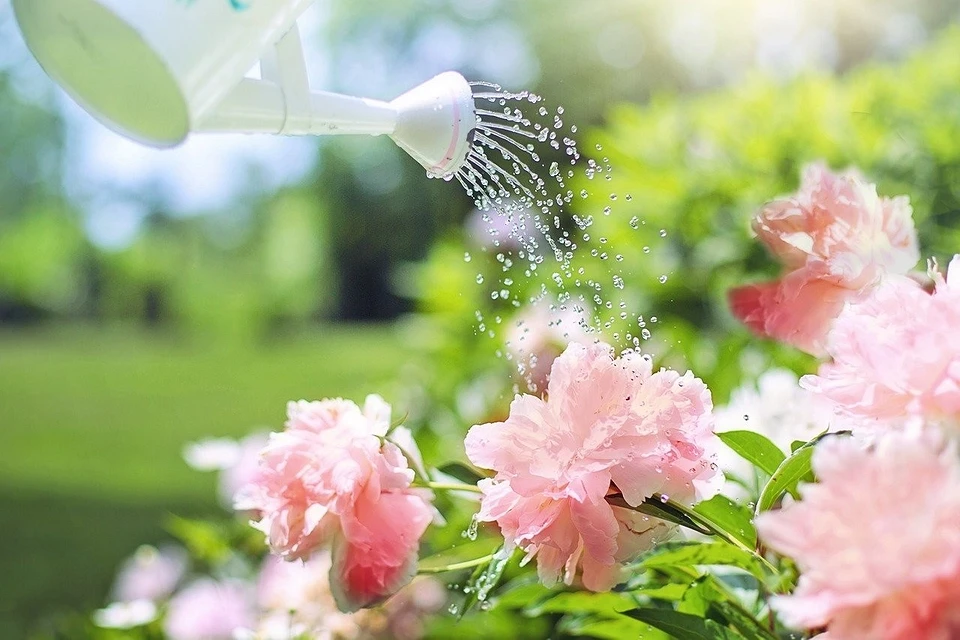
Post-planting care | Pixabay

We have told you how to plant peonies so that they take root quickly and bloom profusely. Follow these simple rules, and you are guaranteed a beautiful flower bed!
❓ Questions and answers

How deep should I plant my peony division for optimal blooms?
Plant the division so that its renewal buds sit about 1.2–1.6 inches (3–4 cm) below the soil surface; in heavy soils, aim for 1 inch (2.5 cm), and in very light soils up to 2 inches (5 cm) deep. Too-deep planting may delay or suppress flowering.
What type of soil and location do peonies prefer to thrive in?
Choose a spot with full morning sun (at least 6 hours) and a fertile, well-draining soil with neutral to slightly alkaline pH. Avoid heavy shade, soggy ground, or low-lying areas prone to waterlogging—these conditions hinder vigorous flowering.
Why did my newly planted peony not bloom the first season, and what can I do?
It’s common for newly planted peonies, especially if planted in spring, to skip blooming while focusing on root development. To encourage better blooms later, avoid removing all buds—leave one or two—and prioritize healthy root growth before expecting full flowering.
Can I divide and transplant peonies in summer, or should I wait?
Dividing or transplanting peonies during June or July (flowering season) is not recommended. The plant is using its energy for blooms, so dividing at that time can severely set it back. Late August or early September is more suitable.
Sofia Lorenson: An expert in floriculture and floristry with 10 years of experience. I will help you create the garden of your dreams, which will bloom from spring to fall.


11 Responses
[…] Features of planting peonies: how to achieve lush flowering? […]
[…] Features of planting peonies: how to achieve lush flowering? […]
[…] case. These flowers need fertilizer support before the cold season. We will tell you what to feed peonies in the fall and how to do it […]
[…] Features of planting peonies: how to achieve lush flowering? […]
[…] flowering. Not all flower growers know how to do this. Let’s figure out when and how to feed peonies so that they bloom beautifully for a long […]
[…] Features of planting peonies: how to achieve lush flowering? […]
[…] Features of planting peonies: how to achieve lush flowering? […]
[…] Features of planting peonies: how to achieve lush flowering? […]
[…] Features of planting peonies: how to achieve lush flowering? […]
[…] Features of planting peonies: how to achieve lush flowering? […]
[…] Features of planting peonies: how to achieve lush flowering? […]