
How far apart should cabbage be planted in beds: recommendations in figures

We discuss the characteristics of growing and planting patterns for white cabbage, colored cabbage, and other common cabbage varieties. We provide helpful tips on planting and care.
Before transplanting seedlings or sowing seeds, gardeners need to dig up the plot and apply fertilizer. But that’s not the whole list of urgent tasks. They need to plan the garden and choose a planting scheme. Not everyone knows that the distance between cabbages when planting affects their size, weight, and even the taste of the future harvest. Let’s figure out what it should be for white cabbage, colored cabbage, and other cabbage varieties.
All about cabbage planting patterns
Features of white cabbage cultivation techniques
It is a biennial plant. In its first year, it forms a dense head of leaves, and in its second year, it forms a stem with flower stalks and fruits. The head that forms in the first year is used for food. Depending on the variety, it can vary in shape, density, and size. The growing season for early-maturing varieties is 95-120 days, for mid-maturing varieties it is 110-150 days, and for late-maturing varieties it is 150-190 days.
White cabbage is cold-resistant but sensitive to light, and it requires adequate moisture and nutrients. It is grown using both seedling and non-seedling methods. In the first case, sowing is carried out in individual containers or boxes. The grown seedlings are transplanted to a permanent place. In the second case, the seeds are sown in a bed, two or three seeds per hole. Then the seedlings are thinned out, leaving the strongest ones.


Planting pattern for white cabbage in open ground
When you choose a planting pattern, please consider the crop’s varietal characteristics.
Early varieties
The general planting pattern for early cabbage in open ground is 20 x 20 inches. This is the optimal distance between bushes. That is, the interval between heads in a row and between rows is made equal. If there is a shortage of free space, you can slightly thicken the planting, since early-maturing heads grow small. Then the seedlings are planted at an interval of 12-14 inches, leaving a row spacing of 16 inches or slightly more.


Mid-season varieties
This variety takes a little longer to ripen, but its heads are larger. They are used fresh and are rarely stored. The optimal spacing for planting these bushes is 20-28 inches between rows. At the same time, varietal characteristics are taken into account. Leave more space for large-fruited varieties. Leave at least 28-31 inches between rows, or more if possible. This will make it easier to care for the plants.


Late varieties
These are the largest heads, which take the longest to ripen. Each can weigh several kilograms, so they require a lot of space. The planting pattern for late cabbage requires a minimum spacing of 20 inches between plants within a row, with larger spacing for large-fruited varieties. Leave at least 33-35 inches between rows. Increase the aisles if possible. Late-maturing crops do not tolerate crowding. Crops grown in such conditions do not store well.
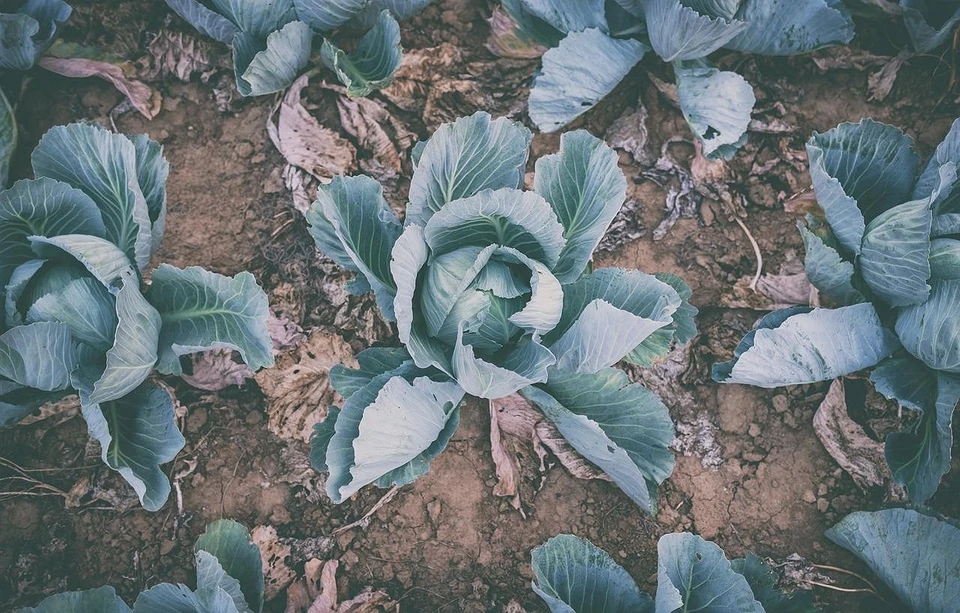

Features of cauliflower
The crop got its name because of the appearance of its overgrown flower stalks, which resemble inflorescences. It is an annual plant with a very long growing season. However, the modified fleshy shoots and inflorescences are used for food. They form much earlier than the seeds. The crop is grown from seedlings, and the seedless method is selectively used in southern regions.
The plant is heat-loving and very demanding in terms of lighting, soil composition, and moisture content. It has a poorly developed root system near the surface. Therefore, the soil must always be moist. The slightest changes in conditions affect the growth of the vegetable. There are early and late-ripening varieties. The former ripens in 80-90 days, the latter in 120-150 days. They do not differ significantly in head size. Growing conditions more influence this.


Scheme for planting cauliflower in open ground
Seedlings are planted in rows with aisles between them. When you choose a planting scheme, please focus on the variety description. In general terms, it is as follows.
- Early-maturing varieties. The interval between bushes in a row is 12 inches, and the row spacing is 20 inches.
- Late-maturing varieties. The distance between bushes is 18 inches, and the row spacing is 20 inches.
These are the minimum dimensions; large-fruited bushes are best planted further apart. They do not like crowding. In unfavorable conditions, the flower heads will not form.


Agronomic characteristics of broccoli
This is an annual plant with green, modified inflorescences used for food. It is sometimes confused with cauliflower, but they are different species. Broccoli is heat-loving, but can withstand short-term cold spells.
It is demanding in terms of substrate nutrition. Some broccoli varieties overripen very quickly, so it is important to harvest them on time. It can be grown using seedlings or without seedlings. The latter method is more suitable for warm regions.


Broccoli planting scheme
To grow broccoli, prepare beds whose size is determined by the convenience of caring for the bushes. The planting scheme for cabbage in open ground, whether using seedlings or seeds, is the same. Seedlings are planted in rows 12-14 inches apart, with a row spacing of 22-24 inches. It is better to have more space so that it is convenient to water and weed the beds. Important point. When planting, the seedling should be deepened to the leaf plates so that the entire stem is covered.


Planting schemes for other varieties
In addition to white cabbage, broccoli, and cauliflower, which are considered the most common, gardeners grow other types of cabbage. Let’s take a look at planting schemes for less common vegetable garden varieties.
- Red cabbage. Easily recognizable by its dark blue, red, or purple head. Grows quite large. Early varieties are planted 14 inches apart in a row, with 26 inches between rows. Late varieties, which are larger, are planted 26 inches apart in a row with 35 inches between rows.
- Savoy. The heads are formed from dark green “corrugated” leaves. They are never large. The average weight is 2.2-3.3 pounds. Therefore, seedlings are planted 16 inches apart. The row spacing is 24 inches.
- Brussels sprouts. This plant with many small heads grows quite large. Therefore, seedlings are placed in holes 39 inches apart. The aisle between them is at least 30-31 inches wide.
- Kohlrabi. A fast-growing variety of white cabbage with a thickened stem. Two or even three harvests are taken per season. The bush is small, so they are planted 12 inches apart in a row. A row spacing of 16-18 inches is sufficient.


Practical recommendations for planting and care
We have compiled helpful tips and agricultural techniques that will help you grow a bountiful harvest of vegetables.
- Transplant seedlings on a cloudy, warm day. There should be no bright sun or heat. Otherwise, it will be more difficult for young bushes to take root. The optimal temperature is 59-64.4˚F. Sudden cold snaps or warm spells are highly undesirable in the first few days after planting. Cabbages do not like temperature fluctuations. In particularly unfavorable conditions, they will not form heads.
- The location for cabbage beds should be chosen in a well-lit, open area. A lack of light harms crop growth. It does not form heads well, and those that do grow are small. In addition, in a shaded area, the ripening period is significantly delayed.
- Take crop rotation into account. All cabbage crops react negatively to undesirable “predecessors.” So, if radishes, rutabagas, turnips, or any other cruciferous vegetables were grown in the beds before them, all the pests and pathogens common to them, and there are many of them, will move to the new plantings. It is best to grow all cabbage crops after tomatoes, perennial herbs, or potatoes.
- Before transplanting or sowing, it is essential to prepare the holes correctly. You can add any suitable mineral or organic fertilizer. For example, add a handful of sand, a handful of peat, and two handfuls of humus to each hole. You can also add a little ash. Mix all the ingredients and sprinkle with a thin layer of soil mixture. After that, water generously and allow the moisture to soak in.
- When planting, it is essential to choose the correct depth of the hole. When sowing, each seed is buried 0.67-0.79 inches deep. If the depth is too great, the seedlings will not be able to break through to the surface; if it is too shallow, the seeds will be washed out of the soil during watering. When transplanting, the seedlings are buried 4-6 inches deep. Focus on the length of the roots. They should fit freely in the hole without bending or breaking.
- Cabbage rows should be even, with equal spacing. This simplifies care: loosening, hilling, and other procedures.


During the first few days after transplanting, cabbage seedlings should be watered daily. This facilitates adaptation to new conditions. It is best to water each bush from a watering can in the evening, using cool water. After the adaptation period, watering is reduced to twice a week. Once the heads have formed, watering is reduced even further. Otherwise, the cabbage heads may crack from excess moisture.
❓ Questions and answers

How much distance should I leave between rows for mid- and late-season cabbage?
For mid-season cabbage, aim for 20–28 inches (≈ 50–70 cm) between plants in a row and 28–31 inches (≈ 70–80 cm) between rows. For late-season (larger) varieties, use at least 20 inches (≈ 50 cm) between plants and 33–35 inches (≈ 85–90 cm) between rows to allow enough space for large heads and ensure ease of maintenance.
Can I plant cabbage closer together if space is limited?
Yes — for early varieties, you can slightly reduce spacing (for example, 12 inches between plants) if space is tight. But for mid and late varieties, reducing spacing too much risks smaller heads, increased competition for nutrients, and higher disease pressure. Always ensure adequate airflow and room for care operations (weeding, watering).
Does spacing affect the yield and head size of cabbage?
Absolutely. Proper spacing ensures each plant gets enough light, nutrients, and air circulation. If cabbage is planted too close, heads may be smaller, plants may compete and stress each other, and disease risk increases. On the flip side, generous spacing can lead to fuller heads and better yields, especially for larger varieties.
How should I plan cabbage spacing in raised beds (typical U.S. garden setups)?
In raised beds (for example, 4 ft or 5 ft wide), center the rows with the spacing recommendations above and leave pathways for access. For instance, two parallel rows across a 4-5 ft bed with 12–16 inches between rows and sufficient side access usually works well. Also consider bed width and ease of reaching plants when designing your layout.
Hi, I’m Ben Carter!
I’m a certified organic vegetable specialist with over 12 years of experience. I grew up on a farm in Iowa and have helped hundreds of gardeners grow bountiful harvests without unnecessary chemicals. On this site, I share my proven methods. If you have any questions, leave them in the comments!



3 Responses
[…] How far apart should cabbage be planted in beds: recommendations in figures […]
[…] How far apart should cabbage be planted in beds: recommendations in figures […]
[…] are particularly incompatible. Both varieties suffer a sharp decline in yield. The minimum distance between cabbage rows is 3.3 feet. It is not advisable to plant cabbage near nightshade plants. The latter are prone to […]